


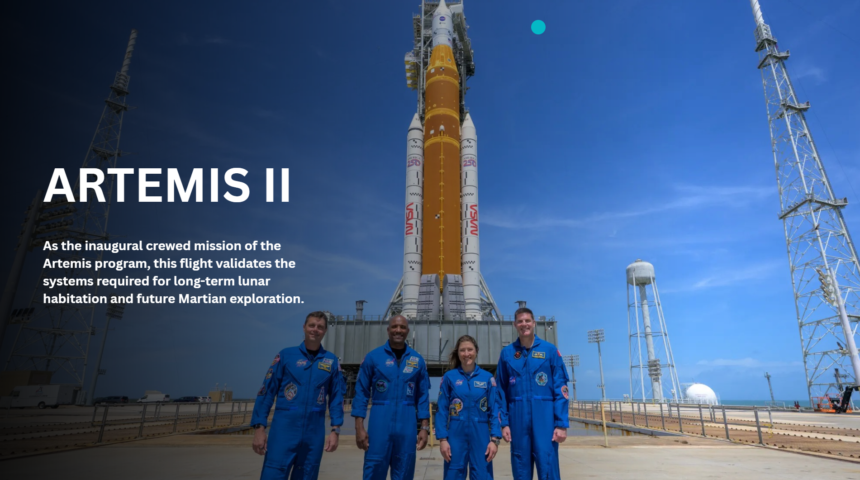
The wait is nearly over. After more than five decades, a crewed spacecraft is once again perched atop a pillar of fire at Kennedy Space Center, ready to break the bonds of Earth’s orbit. Tomorrow, April 1, 2026, NASA’s Artemis II mission is scheduled to lift off, carrying four astronauts on a journey that will redefine human space exploration.
At Vox Bulletin, we’re tracking the final 24 hours of the countdown. Here is everything you need to know about this historic flight.
🚀 Launch Window and “Go” Status
As of this morning, NASA flight controllers have officially begun the terminal countdown. The Space Launch System (SLS) rocket and Orion capsule are “Go” for launch from Launch Complex 39B.
- Launch Date: Wednesday, April 1, 2026
- Primary Window Opens: 6:24 PM EDT (22:24 UTC)
- Weather Forecast: 80% Favorable (Primary concerns: Cumulus clouds and offshore winds).
- Live Stream: NASA+ and YouTube coverage begins at 12:50 PM EDT.
SEO Note: If you miss the April 1 window, NASA has daily backup opportunities available through April 6.
👨🚀 The Crew: Breaking Records and Barriers
Artemis II is not just a technical test; it is a cultural milestone. The four-person crew represents a new era of diversity in deep space:
- Reid Wiseman (Commander): A veteran U.S. Navy pilot who will lead the first crewed lunar mission of the 21st century.
- Victor Glover (Pilot): Glover will make history as the first person of color to leave Earth’s orbit and travel to the Moon.
- Christina Koch (Mission Specialist): Already the record-holder for the longest single spaceflight by a woman, she now becomes the first woman to fly a lunar mission.
- Jeremy Hansen (Mission Specialist): Representing the Canadian Space Agency (CSA), Hansen is the first non-American to ever head toward the Moon.
📍 The Mission Path: The “Free-Return” Trajectory
Unlike the Apollo missions, Artemis II will not enter lunar orbit or land. Instead, it will use a Free-Return Trajectory.
After spending the first 24 hours in a high Earth orbit to test life-support systems, the Orion spacecraft will perform a Trans-Lunar Injection (TLI). Orion will fly 4,700 miles beyond the far side of the Moon—reaching a total distance of 248,655 miles from Earth. This will break the record for the farthest distance from Earth ever reached by a crewed spacecraft (previously held by Apollo 13).
The Moon’s gravity will act as a natural “slingshot,” pulling the crew back toward Earth for a high-velocity splashdown in the Pacific Ocean on April 10, 2026.
⚠️ Space Weather Alert: The X-Flare Factor
The mission faces an unexpected challenge: Space Weather. On March 29, a powerful X1.4 solar flare erupted from the Sun, triggering minor radio blackouts on Earth. NASA’s Space Weather Prediction Center is monitoring the situation closely. While the Orion spacecraft is heavily shielded against radiation, mission controllers are keeping a close eye on solar activity to ensure the crew’s safety during the 10-day journey.
📝 Why Artemis II Matters for the Future
This mission is the final “green light” required for Artemis III, currently slated for 2028, which will land the first humans on the Lunar South Pole. By testing the Orion’s manual handling and deep-space communication systems (including the new O2O optical laser system), NASA is ensuring that we aren’t just visiting the Moon—we are staying there.
Stay tuned to Vox Bulletin for live updates throughout the launch window tomorrow.